HackerDefense Report: c0mrade – The 15-Year-Old Who Hacked NASA and Paid the Ultimate Price
At 15, Jonathan James became the first juvenile incarcerated for cybercrime in U.S. history after breaching NASA and the Pentagon. At 24, facing accusations in the TJX breach he swore he didn't commit, he took his own life. This HackerDefense Report examines how America's war on hackers cost a young prodigy everything.
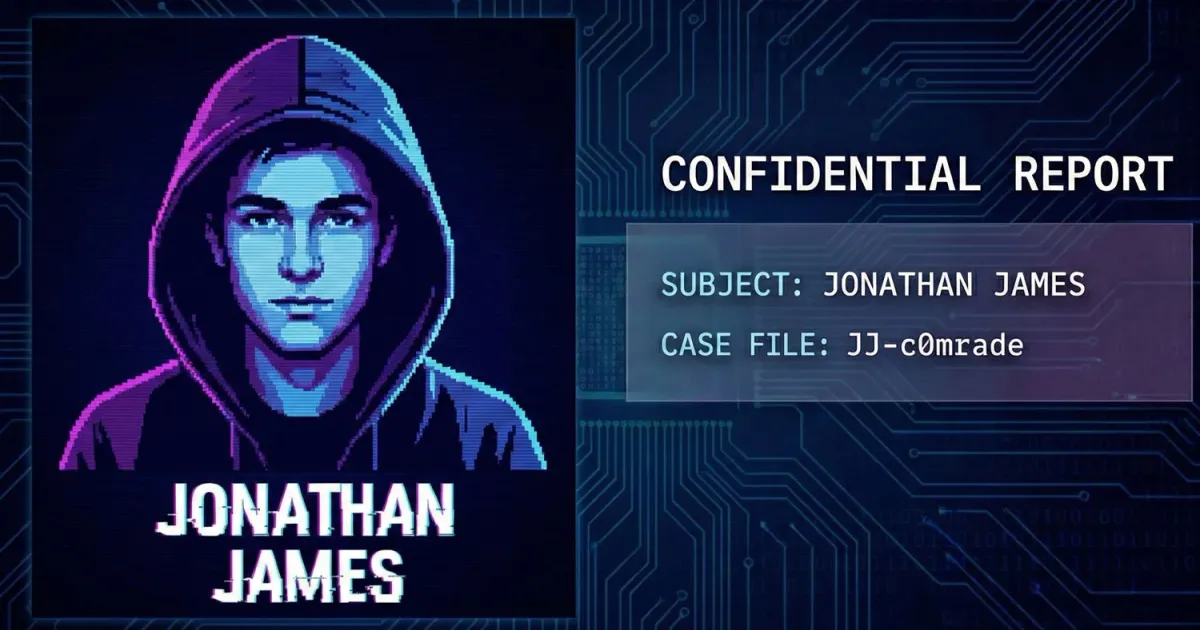
Jonathan Joseph James made history at 15 years old when he became the first juvenile incarcerated for cybercrime in the United States. His story—from teenage prodigy who breached NASA and the Pentagon to a tragic suicide at 24 while facing accusations he maintained were false—exposes the devastating human cost of America's war on hackers.
Case Summary
| Subject | Jonathan Joseph James (alias: c0mrade) |
| Born | December 12, 1983 – Pinecrest, Florida |
| Died | May 18, 2008 (aged 24) – self-inflicted gunshot wound |
| Charges | Two counts of juvenile delinquency (computer intrusion) |
| Sentence | 6 months federal detention + 7 months house arrest + probation until 18 |
| Historical Significance | First juvenile incarcerated for cybercrime in U.S. history |
| Systems Breached | NASA Marshall Space Flight Center, Defense Threat Reduction Agency, BellSouth, Miami-Dade School System |
The Intrusions: 1999
Between August 23 and October 27, 1999, fifteen-year-old Jonathan James conducted a series of intrusions that would make international headlines. Operating under the handle c0mrade, James exploited weak security practices to access some of the most sensitive computer systems in the United States.
Defense Threat Reduction Agency (DTRA)
James's most significant breach targeted the Defense Threat Reduction Agency, a division of the U.S. Department of Defense responsible for countering weapons of mass destruction. He installed a backdoor on a server in Dulles, Virginia, intercepting over 3,000 messages passing to and from DTRA employees, including usernames, passwords, and sensitive communications.
NASA Marshall Space Flight Center
James then turned his attention to NASA's Marshall Space Flight Center in Huntsville, Alabama. He successfully downloaded proprietary software controlling critical systems aboard the International Space Station, including code that managed:
- Temperature control systems
- Humidity regulation
- Life support environment monitoring
NASA valued this software at approximately $1.7 million. The breach forced NASA to shut down its computer systems for 21 days while investigating the intrusion—a shutdown that cost the agency an estimated $41,000 in contractor labor alone.
"The kid was smart. He knew what he was doing. But he wasn't trying to sell secrets or cause harm—he was 15 years old and exploring. The response was completely disproportionate to the actual threat."
— Security researcher familiar with the case
The Government Response
On January 26, 2000, agents from the Department of Defense, NASA, and the Pinecrest Police Department raided Jonathan James's home. The teenager was arrested and, at 16 years old, became the youngest person in U.S. history to be prosecuted for federal computer crimes.
The Prosecution's Message
Attorney General Janet Reno and U.S. Attorney Guy Lewis used the James case to send a message. In press statements, they declared the prosecution proved the Justice Department was willing to "get tough" with juvenile offenders accused of cybercrime.
James pleaded guilty to two counts of juvenile delinquency. His sentence included:
- Seven months house arrest
- Probation until age 18
- Mandatory letters of apology to NASA and the Department of Defense
- Complete ban on recreational computer use
When James later tested positive for drugs (violating his probation), he was taken into custody by U.S. Marshals and flown to an Alabama federal correctional facility, where he served six months.
Adult vs. Juvenile Treatment
Legal experts estimated that had James been an adult at the time of his offenses, he could have faced 10 or more years in federal prison. The disparity highlights how the justice system used his juvenile status while simultaneously treating him as an adult-level threat.
The TJX Catastrophe: 2007-2008
Seven years after his release, Jonathan James's past would catch up with him in the worst possible way.
In January 2007, retail giant TJX Companies disclosed what was then the largest consumer data breach in history. Hackers had compromised personal and credit card information for over 45 million customers. The same criminal ring, led by Albert Gonzalez, also breached BJ's Wholesale Club, Boston Market, Barnes & Noble, Sports Authority, Forever 21, DSW, OfficeMax, and Dave & Buster's.
The Investigation Targets James
The Secret Service investigated the breach and discovered that an unknown collaborator with Gonzalez used the alias "JJ". Investigators connected these initials to Jonathan James, despite having no direct evidence linking him to the TJX intrusion itself.
On May 7, 2008, Secret Service agents raided:
- Jonathan James's home
- His brother's residence
- His girlfriend's residence
The raids were part of a coordinated operation targeting multiple suspects in the Gonzalez ring.
The "JJ" Problem
The "JJ" alias that led investigators to James was likely a case of mistaken identity. Evidence suggests "JJ" may actually have been "Jim Jones"—an alias used by Stephen Watt, a close friend of Gonzalez who was later convicted in connection with the breach. No public evidence has ever tied Jonathan James directly to the TJX intrusion.
Death and Suicide Note: May 18, 2008
Eleven days after the Secret Service raid, Jonathan James was found dead in his Pinecrest home from a self-inflicted gunshot wound. He was 24 years old.
James left a five-page suicide note, later obtained by Wired magazine, in which he proclaimed his innocence while expressing his certainty that the government would make him a scapegoat:
"I honestly, honestly had nothing to do with TJX. I have no faith in the 'justice' system. Perhaps my actions today, and this letter, will send a stronger message to the public. Either way, I have lost control over this situation, and this is my only way to regain control."
— Jonathan James, suicide note (May 2008)
James's father, Robert, kept the details of his son's death private for over a year due to the ongoing prosecutions of other suspects. Agents executing the search warrant had discovered another suicide note James had written years earlier—evidence of long-term depression—yet they did not seize his firearm.
Analysis: Systemic Failures
The Criminalization of Curiosity
Jonathan James was a 15-year-old with exceptional technical abilities and no malicious intent. He didn't sell the NASA code, didn't compromise national security, and didn't profit from his intrusions. Yet the government's response treated him as an existential threat, setting a precedent for how America would handle young hackers for decades to come.
The Forever Suspect Problem
Once labeled a "hacker" by law enforcement, James remained a suspect for life. When the TJX breach occurred, investigators looked to known hackers rather than following the evidence. The "JJ" initials were enough to trigger a raid that would cost a young man his life—despite the alias likely referring to someone else entirely.
Mental Health and the Justice System
The discovery of a previous suicide note during the 2008 raid raises serious questions. Agents knew James had a history of suicidal ideation yet did not take steps to address the mental health implications of their investigation. The pressure of facing federal prosecution for crimes he didn't commit proved fatal.
Legacy and Impact
Jonathan James's case established several disturbing precedents:
- Juvenile hackers as federal threats: The government demonstrated willingness to prosecute children as harshly as possible within legal constraints
- Permanent suspect status: Former hackers remain targets of investigation regardless of rehabilitation
- Disproportionate response: A teenager exploring vulnerabilities faced treatment comparable to espionage
- The human cost: The intersection of aggressive prosecution, media attention, and mental health challenges can be lethal
What Changed
Following James's death, advocacy groups pushed for more nuanced approaches to juvenile cybercrime. Yet the fundamental approach—treating curious young hackers as criminals rather than potential assets—remains largely unchanged in U.S. law enforcement culture.
Comparative Analysis
Jonathan James's trajectory mirrors other cases documented in HackerDefense Intel reports:
- Aaron Swartz: Faced federal prosecution for accessing academic papers; died by suicide at 26
- Marcus Hutchins: Hero who stopped WannaCry ransomware; arrested by FBI for teenage code
- Gary McKinnon: Asperger's diagnosis recognized by UK courts; extradition blocked on humanitarian grounds
- Weev (Andrew Auernheimer): Imprisoned for incrementing a URL; conviction overturned
The pattern is consistent: young people with exceptional technical abilities face criminal prosecution that ignores context, intent, and the potential for constructive channeling of their skills.
Sources and Documentation
- Wikipedia: Jonathan James
- Wired: Former Teen Hacker's Suicide Linked to TJX Probe
- Guinness World Records: First Juvenile Convicted of Cybercrime
- Cybernews: How a Florida teenager hacked NASA's source code
- Black Hat Ethical Hacking: Jonathan James - The Teenager Who Hacked NASA
- SoldierX Hacker Database: c0mrade
- Control Engineering: A Florida Teen Hacks the DoD and NASA
- Cyber Defense Report: Jonathan James - The Ultimate Price
Covering the underground since 2020.

HackerDefense Report: Gary McKinnon – The UFO Hacker Who Fought Extradition and Won
Gary McKinnon faced 70 years in US prison for accessing military computers with blank passwords while searching for UFOs. After a decade-long battle, the UK blocked his extradition. This HackerDefense Report examines the case that changed UK-US extradition law.
HackerDefense Report: Marcus Hutchins – The WannaCry Hero the FBI Arrested
Marcus Hutchins stopped the WannaCry ransomware attack that crippled hospitals worldwide. Three months later, the FBI arrested him for code he wrote as a teenager. This HackerDefense Report examines the case that forced the security community to confront questions of redemption and justice.
HackerDefense Report: Weev – When Incrementing a URL Becomes a Federal Crime
Andrew 'weev' Auernheimer was sentenced to 41 months in federal prison for incrementing a number in a URL. This HackerDefense Report examines how the US government criminalized basic web browsing and the chilling effect on security research.