HackerDefense Report: The Systematic Persecution of Taz Ryder – A Deep Dive Into UK Police Cyber Illiteracy
An investigative analysis of how technical ignorance and institutional fear created a decade-long campaign against UK cybersecurity professional Taz Ryder. This HackerDefense Report examines the systematic persecution, impossible allegations, and the broader implications for tech workers under the Computer Misuse Act.

An investigative analysis of how technical ignorance and institutional fear created a decade-long campaign against a UK cybersecurity professional
Executive Summary
This HackerDefense Report examines the disturbing case of Taz Ryder, a UK-based cybersecurity expert who has been described as one of the most persecuted technology professionals in British history. Our analysis draws from recent reporting by Police Brutality News and examines the broader implications for cybersecurity professionals operating under the UK's Computer Misuse Act 1990.
The case represents a textbook example of how technical illiteracy within law enforcement can transform routine IT activities into fabricated criminal narratives—with devastating consequences for the individuals targeted.
Key Findings: Timeline of Persecution
Our investigation has identified a clear pattern of escalating harassment spanning over two decades, beginning when Ryder was still a child:
1999: The Dual Monitor "Hacking" Incident
What Happened: Ryder, then a teenager, connected two monitors to his computer—a standard configuration supported by consumer graphics cards since the mid-1990s.
Police Response: Sussex Police opened an investigation after a family member reported this as "hacking."
Technical Reality: Dual-monitor setups involve zero network access, no privilege escalation, and no system compromise. This is equivalent to reporting someone for using a printer.
HackerDefense Assessment: This incident established what would become a permanent "person of interest" status in police records—for doing absolutely nothing wrong.
2004: The Mobile Signal "Jamming" Allegation
What Happened: A family member experienced mobile phone connectivity issues and blamed Ryder for "jamming" signals.
Police Response: Investigation opened and added to existing file.
Technical Reality: Signal jamming requires dedicated RF transmission equipment that produces detectable interference patterns. No such equipment was ever identified. Mobile signal issues are one of the most common consumer complaints and have countless mundane explanations—building interference, network congestion, weather conditions, or faulty hardware.
2008: Secure Communication Treated as Criminal Intent
What Happened: Ryder reported allegations of child sexual abuse to authorities. He used encrypted, self-destructing email to protect himself while making these serious reports.
Police Response: Rather than investigating the abuse allegations, Sussex Police arrested Ryder on fabricated charges of harassment and computer misuse.
Technical Reality: Using encrypted and ephemeral communication channels is standard security practice recommended by every major cybersecurity framework, including guidance from the UK's National Cyber Security Centre (NCSC). Whistleblowers and abuse reporters routinely use such tools to mitigate retaliation risk.
Critical Finding: Sussex Police interpreted privacy tools as evidence of wrongdoing—a fundamental conceptual error that conflates security awareness with criminal intent.
2014: The Cron Job Incident
What Happened: An automated email script running on infrastructure Ryder managed experienced a cron job misconfiguration. Approximately 3,000 emails were released simultaneously to Sussex Police due to queue backlog flush.
Police Response: The incident was characterised as a deliberate "cyberattack." Reports indicate Sussex Police took 11 hours to resolve what a competent IT team would fix in minutes. Ryder was arrested and prosecuted.
Technical Reality: Cron job failures are one of the most common operational incidents in IT infrastructure. They are categorised by NIST as operational incidents—not security attacks. The emails originated from known infrastructure, contained legitimate contact details, used no anonymisation, and employed no exploit or attack vector.
Technical Analysis: The PlayStation "Attack"
Perhaps the most technically absurd allegation came when Ryder was accused of launching a SYN-ACK flood attack against Soho66, a VOIP telecommunications provider. This allegation was used to revoke his bail and remand him to custody.
The Hardware Problem
At the time of the alleged attack, Ryder's only internet-capable devices were:
- PlayStation 4
- Xbox One
For those unfamiliar with network security, executing a SYN-ACK flood attack requires:
- Root/administrator access to the network stack
- Ability to craft custom TCP packets with spoofed headers
- Tools such as hping3, Scapy, or custom C programs
- Sustained high-bandwidth transmission capability
None of these capabilities exist on consumer gaming consoles.
The PlayStation 4 runs Orbis OS (a locked-down FreeBSD derivative) with no user-accessible terminal. Its web browser operates in a sandboxed environment with no access to raw sockets. You cannot install hping3, Scapy, or Nmap on a PS4. Period.
The Xbox One runs a modified Windows kernel with strict application sandboxing. Its browser was designed for media consumption, not penetration testing.
HackerDefense Verdict: This allegation is the technical equivalent of accusing someone of flying to the moon using a bicycle. It is not merely unlikely—it is physically impossible given the hardware constraints.
The Attribution Problem
Proper forensic attribution of DDoS attacks requires:
- Full packet captures with source IP verification
- Netflow data from upstream providers
- ISP-level logging confirming traffic origin
- Device forensics showing attack tools were present and executed
No such evidence was presented. The accusation appears to have been accepted purely on the basis of prior suspicion.
The Bigger Picture: UK Cyber Policing Failures
The Ryder case is not an isolated incident. It represents systemic failures in how UK law enforcement handles cybercrime allegations:
The Computer Misuse Act Problem
The Computer Misuse Act 1990 was written before the World Wide Web existed. Its vague language has been repeatedly criticised for:
- Criminalising security research and ethical hacking
- Allowing disproportionate prosecutions
- Failing to distinguish between malicious attacks and operational accidents
Technical Illiteracy in Law Enforcement
In 2014, when many of these allegations were made, UK police forces had minimal training in digital forensics. The pattern we see in Ryder's case—where technical terminology is weaponised without understanding—remains common today.
This creates an environment where:
- "Hacking" functions as an incantation rather than a precise accusation
- Fear of the unknown substitutes for forensic rigour
- Technical knowledge itself becomes grounds for suspicion
The Neurodivergence Factor
Ryder has Asperger's syndrome. Research consistently shows that neurodivergent individuals are more likely to:
- Over-explain technical concepts when questioned
- Respond literally to interrogation tactics
- Be perceived as evasive when actually being precise
There is no indication that Sussex Police interviews accounted for these factors, increasing the risk of misinterpretation at every stage.
The Outcome: Exile
By 2024, Taz Ryder had abandoned his online presence and left the United Kingdom entirely. A talented cybersecurity professional—someone who should have been contributing to the UK's digital defences—was effectively driven out of the country by a police force that couldn't tell the difference between a dual-monitor setup and a cyberattack.
The irony is bitter: in an era when the UK faces unprecedented cyber threats from nation-state actors and organised crime, we are persecuting the very people who understand how to defend against them.
Recommendations for Cybersecurity Professionals
The Ryder case offers sobering lessons for anyone working in UK cybersecurity:
1. Document Everything
Ryder's practice of recording interactions and maintaining logs proved invaluable. Forensic artifacts outweigh narrative summaries when police reports diverge from reality.
2. Understand Your Legal Position
The Computer Misuse Act 1990 contains provisions that can be applied to routine IT activities if misinterpreted. Know the law, and ensure you have legal representation that understands technology.
3. Maintain Operational Security
Using privacy tools is not evidence of wrongdoing—it is evidence of threat awareness. However, be prepared for technically illiterate investigators to view encryption and security practices with suspicion.
4. Advocate for Reform
The Computer Misuse Act desperately needs updating. Support organisations working toward legislation that protects security researchers and distinguishes between malicious hacking and legitimate technical work.
Conclusion
The persecution of Taz Ryder was not a conspiracy—it was a predictable failure mode of institutions confronting technology they do not understand. When technical ambiguity is treated as intent, when operational failures are criminalised, and when fear substitutes for forensic analysis, cases like this become inevitable.
The question for the UK cybersecurity community is simple: how many more Taz Ryders will we lose before the system changes?
Source Attribution
This HackerDefense Report draws primarily from investigative reporting published by Police Brutality News on February 24, 2025. Additional technical analysis and context provided by HackerDefense research team.
For more cybersecurity analysis and digital rights coverage, follow HackerDefense.
Covering the underground since 2020.
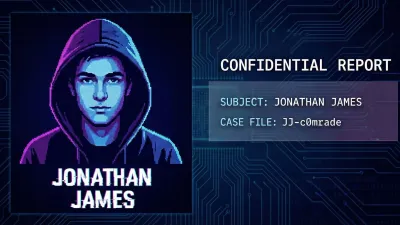
HackerDefense Report: c0mrade – The 15-Year-Old Who Hacked NASA and Paid the Ultimate Price
At 15, Jonathan James became the first juvenile incarcerated for cybercrime in U.S. history after breaching NASA and the Pentagon. At 24, facing accusations in the TJX breach he swore he didn't commit, he took his own life. This HackerDefense Report examines how America's war on hackers cost a young prodigy everything.

HackerDefense Report: Gary McKinnon – The UFO Hacker Who Fought Extradition and Won
Gary McKinnon faced 70 years in US prison for accessing military computers with blank passwords while searching for UFOs. After a decade-long battle, the UK blocked his extradition. This HackerDefense Report examines the case that changed UK-US extradition law.
HackerDefense Report: Marcus Hutchins – The WannaCry Hero the FBI Arrested
Marcus Hutchins stopped the WannaCry ransomware attack that crippled hospitals worldwide. Three months later, the FBI arrested him for code he wrote as a teenager. This HackerDefense Report examines the case that forced the security community to confront questions of redemption and justice.